-
Are adequate ethical guardrails in place? What are the gaps in ethical literacy among practitioners and users? How to use AI while preserving human-centered principles?
-
How to discuss AI use with patient? How to protect data privacy and sustain trust? How to obtain and revisit consent?
-
Is the patient’s privacy adequately protected? What are the latest regulations on AI Companions? Can practitioners be held liable for errors made by AI?
Full Outline
-
Are adequate ethical guardrails in place? What are the gaps in ethical literacy among practitioners and users? How to use AI while preserving human-centered principles? (Chapter by Laura Garcia)
-
When can providers be held liable for AI’s mistakes? How are state and national regulations changing to limit AI’s harms? How is informed consent regulated, in the US, EU and UK? (Chapter by Michiel van Vliet)
-
How to discuss AI use with a patient, while setting clear boundaries and revisiting consent? What are practical strategies here to safeguard privacy and maintain ethical standards? (Chapter by Maia Nahmod)
-
What unique relational pathways to psychological relief does AI offer? What is solely reserved for human care? Can AI fully substitute human care? (Chapter by Laura Garcia)
-
What are both benefits and challenges of using AI Scribes? Do they always improve productivity? Are chatbots safe to use and do they have positive clinical effects? (Chapter by Michiel van Vliet)
-
In what ways can therapist use AI tools for education, training and professional development? What do therapists need to know about AI and how to use AI to support their learning? (Chapter by Joann Kozyrev)
-
How was the evolution of AI shaped by the focus on the Turing Test? How did this influence LLMs’ (e.g., ChatGPT) personalities and how does this redefine therapy and human-machine interactions? (Chapter by Rachel Joy Victor)
-
What is AI in its core? What is a model and how is it ‘trained’? What is the difference between neural networks, deep learning and what are large language models? (Chapter by Michiel van Vliet)
Why we wrote this book
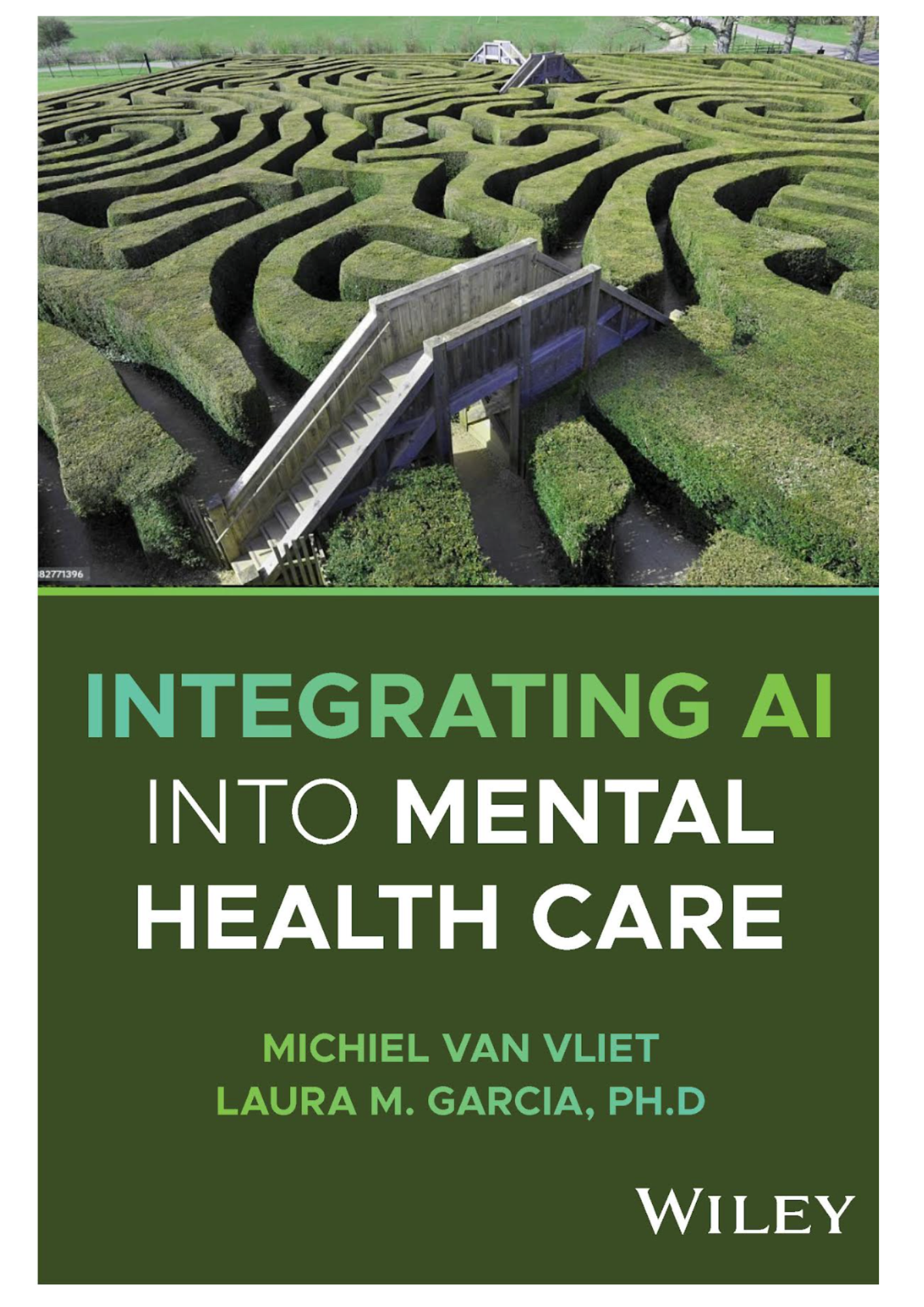
This book offers a practical and hopeful framework for therapists to evaluate AI tools while preserving the essential human connection in clinical practice. We encourage practitioners to move beyond simple adoption and actively collaborate with technologists, to design systems that reflect professional expertise and therapeutic values.
By automating workflows and supporting evidence-based techniques, AI is presented as an ally that enhances professional effectiveness without compromising empathy. Ultimately, clinicians are empowered to integrate technology in a way that amplifies the healing process while maintaining full control over their practice.
First author is Michiel van Vliet MS, second author is Laura Garcia, PhD Clinical Psychology. Other contributors are Maia Nahmod PsyD, Rachel Joy Victor MS and Joann Kozyrev BA.
Michiel van Vliet MS
Michiel underwent psychotherapy and became passionate about mental health care, now he gives back to the therapists that helped him grow.
He combines a background as product owner, health care and AI. Building and improving software.
He holds a Master of Science in Science and Business Management and a Bachelor of Science in Pharmacy.

Laura Garcia PhD

Laura Garcia uses behavioral science to shape how AI and immersive technologies are integrated into mental health care. Her work defines what these technologies can enhance and how and when they should be implemented responsibly.
She holds a PhD in Clinical Psychology and partners with tech leaders, product teams, engineers, and providers to design and evaluate solutions that deliver clinical value at scale.
Subscribe to Newsletter
Updates on the book release
How to transition into digital- and AI-added care